
Themasap Khan, Co-Founder and Partner at Luma Group
Publicly funded basic research has long served as the foundation for breakthroughs. Yet proposed federal cuts, including reductions to the NSF and NIH, now threaten the early-stage research that the private sector traditionally does not fund. These changes have already stalled projects, eliminated jobs, and raised concerns about broader delays in scientific progress.
At the same time, the United States faces intensifying competition with China, whose sustained investment in early-stage biotech has accelerated its global share of drug development. Although the US retains leadership in total R&D value, the trend signals growing vulnerability, one seemingly at odds with the administration’s broader “America First” agenda. The launch of the Genesis Mission, with its emphasis on AI-enabled science and biotechnology as a domain of national importance, hints at a potential restructuring rather than an abandonment of federal scientific priorities.
In this environment, the private sector has emerged as an essential stabilizing force. As public funding recedes, venture capital and philanthropy must intervene earlier in the research lifecycle. This shift can bring rigorous private-sector diligence to basic science, likely focusing resources on fewer projects but with greater efficiency. To handle this complexity, biology-specific AI tools will shift from optional luxuries to indispensable necessities. Ultimately, this disruption offers a chance to modernize our infrastructure: building a resilient ecosystem capable of expanding, not just restoring, American scientific progress.
December 2025
Public Research as the Engine of Private Innovation
The symbiotic relationship between public and private funding has led to amazing feats in science. While many discoveries are labeled “accidental,” they usually stem from scientists investigating fundamental questions, like how a cell responds to stimuli or what happens when a gene is perturbed. These questions form the bedrock of innovative breakthroughs.
For example, Nobel Laureate Dr. William Kaelin recently spoke about his academic work on trying to better understand how cells sense oxygen. His work did not start in trying to cure kidney diseases, which is what it eventually led to, but rather trying to answer a basic question about cell biology.
From penicillin to vaccines, history’s greatest breakthroughs stem from scientists simply asking “why” and “how.” This basic research is vital to scientific advancement, yet it is arguably the most vulnerable to proposed federal funding cuts. The private sector often cannot justify betting its bottom line on open-ended questions with uncertain returns. Without this foundational inquiry, however, the entire scientific pipeline will dry up.
What Changes Have Been Made and Where Are We Now?
The US has fundamentally changed its stance on the value of public sector funding. The 2026 budget proposed a 57% reduction in funding for the National Science Foundation (NSF) and a 40% reduction in funding for the National Institute of Health (NIH). These cuts resulted in 3,800 frozen or cancelled grants, evaporated billions in funding, and stalled thousands of careers.

Figure 1: Current and estimated future economic loss by county due to federal health research cuts
Source: Science Impacts and University of Pennsylvania.
The proposal also attacks the backbone of research: infrastructure. By capping “indirect cost” reimbursements, including the costs of buildings, labs, and other infrastructure necessary to support research at 15% (down from the standard 50-60%). The budget could handicap universities’ ability to power their labs and maintain essential equipment and personnel.
Scientists are already warning of a total standstill in discovery. It is a confusing geopolitical strategy: the administration explicitly aims to restore American global dominance, yet it is starving the very science that fuels international competitiveness. Cutting billions from research saves little in the wider federal budget, but the cost to American innovation and the biotech sector may be incalculable.
The Genesis Mission
On November 24, 2025, the White House announced the launch of The Genesis Mission1, which is largely focused on advancing AI development and research. The order addresses “the need to invest in AI-enabled science to accelerate scientific advancement” and the goal of developing and harnessing AI to address national challenges. The inclusion of biotechnology in the order may be a signal that funding cuts will not be long-term, but that the administration is working on restructuring funding as well as new requirements for funding eligibility, such as programs developing or utilizing AI. Perhaps this is what modern day reforms in science look like.
The order lists biotechnology as one of the “challenges of national importance that the Secretary assesses to have potential to be addressed through the Mission,” and while there are many types of biotechnology, it is not a far cry to consider the healthcare industry “of national importance.” This administration, and this recent executive order, are heavily focused on national security. Healthcare is not the first indicator that comes to mind when hearing those words, but a healthy population certainly contributes to national security.
This order and mission are new and do not directly mention NIH, NSF, or healthcare research, but an open-minded, optimistic citizen can see how the cuts to funding may be connected to a restructuring and updated national goals.
The “America First” Dilemma: Funding AI while abandoning Biotech
The current administration has been clear in their “America First” agenda, with the goal of prioritizing US economic, militaristic, and diplomatic interests rather than multilateral goals. As competition with China continues to grow and we inch towards a more bi-polar system of international power it is crucial that the US focuses policy on restoring and maintaining our international hegemony. During The Cold War, throughout which the US and Soviet Union competed for unipolar power status, a large contributor to America’s ability to establish status as the leading world power was public funding poured into scientific discovery and the rapid advancement of US technologies and economy.
The Genesis Mission mirrors these winning policies and exemplifies the US’s focus on AI advancement and a desire for rapid, well-funded growth in AI and similar technologies. However, it fails to safeguard the biotechnology and healthcare industries, leaving these industries vulnerable to China.
As the US creates a funding vacuum in the life sciences, China is filling it, forcing American industry to rely on our primary competitor for innovation. The impact of this neglect is already visible in the data trends:
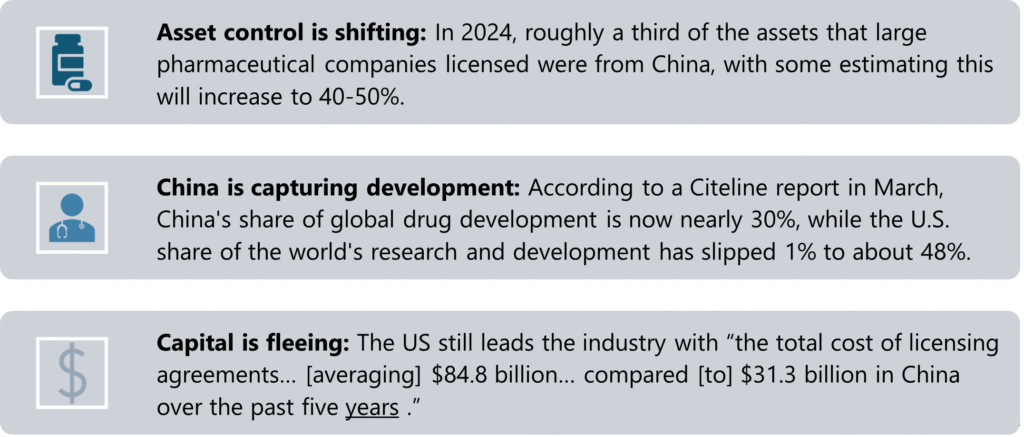
If “America First” remains the objective, the current strategy is self-defeating. One cannot secure international dominance while depending on geopolitical rivals for healthcare solutions. To compete, the US must invest domestically to ensure we remain the first to discover, commercialize, and distribute the medicine of the future.

Figure 2: US-China license deal volumes over the past 10 years.
Source: Reuters from Evaluate’s Biomedtracker.
God Bless The Private Sector
Biopharma venture activity has normalized after the 2021 mania, but it has not collapsed in response to public-funding drama. The resilience of the private sector is backed by strategic venture capital firms, well-funded philanthropies, and strong public-private partnerships, all of which can provide a safety net and maintain scientific and technological advancement in the US as federal funding reform settles into a new normal.
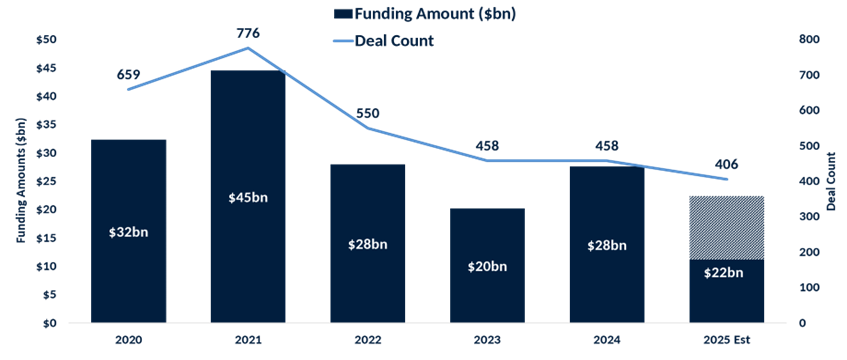
Figure 3: Biopharma venture activity was reset after the 2021 bubble and has stabilized since.
Source: Luma Group internal analysis sourced from DealForma.
The research most at risk of losing public funding is early-stage, high-risk work that often shows little commercial opportunity. This shift may create an opportunity the research industry has not previously had. Unlike the public sector, private investors apply rigorous diligence to protect their stakeholders and returns. As science enters private pipelines earlier, it will face this meticulous scrutiny, and investors will likely pass on projects that might otherwise have received public funding and ultimately failed. Although this could leave a significant portion of research unfunded, it may also drive innovation by pushing scientists toward projects with clearer potential rather than spending years on ideas unlikely to materialize. While applying these standards earlier will be taxing for private investors, it also presents a growth opportunity as they deepen their expertise. Biotech-focused investors, already equipped with relevant knowledge and specialization, stand to benefit more than generalists.
Another significant opportunity lies in the integration of AI into investment firms. As the US prioritizes AI capabilities and innovation, and private investors face an influx of opportunities requiring time-consuming, meticulous diligence, AI will become essential. Investors will increasingly need advanced tools capable of supporting diligence on complex biological questions, making the development of biology-specific AI indispensable in the coming years. Such advancements will enable a more efficient and empowered private sector to make strategic investments and drive scientific innovation in the US. Although it is surprising that no robust tool already exists, emerging policies and declining public funding will be the catalyst that shifts this technology from a “nice to have” to a necessity. It may even lead to a reevaluation and modernization of decades of standard practice, and prompt investment in tools that could fundamentally enhance the capabilities of both researchers and investors.
Choosing to approach these policy changes as an opportunity for reform will ideally lead to a more strategic approach to funding and research for both public and private sectors, rather than relying on a strategy of throwing money at the problem. This chance to reform and integrate new technologies into investment strategies presents an opportunity to build an advanced, efficient, and competitive infrastructure to conduct research in the future. Which means, hopefully, that any research that was stopped or delayed will be made up for tenfold with a reformed and improved system.
It is easy to imagine the system simply collapsing, yet history tells a more grounded story. Since the 1970s, every decade has brought waves of major public-sector science and healthcare cuts. Each time, the system bent but did not break, in large part because the private sector stepped in to fill critical gaps. In several cases, the disruption even paved the way for stronger, more resilient structures. We have good reason to expect that pattern to hold.
- “Launching the Genesis Mission,” The White House, The United States Government, November 24, 2025, https://www.whitehouse.gov/presidential-actions/2025/11/launching-the-genesis-mission/ ↩︎
